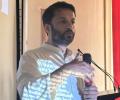
Acting on the Supreme Court's direction, Haryana's Director General of Police Shatrujeet Kapur has constituted a Special Investigation Team (SIT) to investigate two FIRs against Ashoka University associate professor Ali Khan Mahmudabad. The SIT, headed by Additional Director General of Police (Crime) Mamta Singh, will include Superintendent of Police (Karnal) Ganga Ram Punia and Superintendent of Police (STF, Gurugram) Vikrant Bhushan. The SIT will expeditiously complete the investigation and submit a report at the earliest. Mahmudabad was arrested on May 18 for his social media posts on Operation Sindoor, which were alleged to have endangered the sovereignty and integrity of the country. The Supreme Court granted him interim bail on Thursday, but refused to stay the investigation.
The Supreme Court has questioned the central government about the possibility of constructing a border wall to prevent illegal immigration, drawing parallels with the US border policy. The court also addressed concerns about the detention and deportation of Bengali-speaking migrant workers.
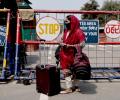
The Supreme Court on Friday directed authorities not to deport to Pakistan six members of a family, who allegedly overstayed their visa, till their citizenship claim is verified.

The Supreme Court of India expressed concerns about the long-term sustainability of providing free rations to migrant workers, emphasizing the need for job creation and capacity building instead. The court's remarks came during a hearing on the ongoing issue of providing relief to migrant workers, a matter that gained prominence during the COVID-19 pandemic. The court questioned the government's reliance on freebies and stressed the importance of creating opportunities for migrant workers to become self-sufficient. The debate highlighted the challenges of balancing immediate relief with long-term economic solutions for vulnerable populations.
The Supreme Court of India has sought the government's response on a Public Interest Litigation (PIL) that challenges the appointment process of the Comptroller and Auditor General of India (CAG), arguing it's unconstitutional. The PIL, filed by the Centre for Public Interest Litigation, claims the current process, solely through executive appointment by the Prime Minister, undermines the CAG's independence and violates constitutional principles. The court, while acknowledging the importance of institutional trust, questioned the extent to which it should intervene in the appointment process and whether this would constitute rewriting constitutional provisions. The PIL suggests the CAG's appointment should be similar to other independent bodies, with a selection committee comprising the Prime Minister, Leader of the Opposition, and Chief Justice of India. The case has implications for the independence and transparency of India's audit system.
The Supreme Court has begun hearing petitions challenging the Election Commission's decision to conduct a special intensive revision exercise in Bihar ahead of elections, raising concerns about voter exclusion.

The Supreme Court of India has reprimanded the Tamil Nadu Pollution Control Board (TNPCB) for delaying legal action against Isha Foundation, a yoga and meditation center founded by Sadhguru Jaggi Vasudev, over alleged environmental violations. The court criticized the TNPCB for taking two years to challenge a Madras High Court ruling that quashed a showcause notice against the foundation. The court also emphasized the importance of environmental compliance for the yoga center, noting that it must meet all necessary parameters. The case highlights ongoing legal challenges and environmental concerns related to the Isha Foundation's activities.

The Supreme Court has questioned the line of investigation adopted by the Haryana SIT in the case of an Ashoka University professor booked for social media posts, stating that it "misdirected itself."
The Supreme Court has directed the Election Commission of India (ECI) to publish details of deleted names from the voters list in Bihar, along with reasons for non-inclusion, to enhance transparency in the special intensive revision (SIR) of the electoral roll.

Underscoring the 'presumption of genuineness' of Aadhaar and voter ID, the Supreme Court on Monday refused to stay the publication of draft electoral rolls in poll-bound Bihar and said it would once and for all decide pleas against Election Commission's special intensive revision (SIR) of electoral rolls.

The Supreme Court of India has announced its intention to establish an effective mechanism to address caste-based discrimination in educational institutions throughout the country. The court directed the University Grants Commission (UGC) to draft regulations to prevent such discrimination and to provide data on institutions that have implemented equal opportunity cells as mandated by the 2012 UGC equity regulations. The court's decision stems from a public interest litigation filed in 2019 highlighting the prevalence of caste-based discrimination in higher education institutions and its tragic consequences, including the suicides of students like Rohith Vemula and Payal Tadvi.
The Centre has opposed the imposition of fixed timelines on governors and the President for decisions on bills passed by state legislatures, arguing that such constraints were intentionally omitted by the Constitution's framers.
The Centre told the Supreme Court that governors are not indefinitely sitting on bills passed by state legislatures, and that barring a few exceptions, most have acted in a way which the apex court would have perhaps desired. Solicitor General Tushar Mehta argued that a Governor is "not a rubber stamp" and has a duty to preserve, protect, and defend the Constitution.
A bench of Justices Surya Kant and N Kotiswar Singh deferred the hearing on Shah's plea after his counsel and senior advocate Maninder Singh made a request.
BJP-ruled states argued in the Supreme Court that governors and the President have autonomy in assenting to bills passed by state assemblies, asserting that courts cannot mandate assent.

"There is bound to be revision," the top court said, "otherwise, how will the poll panel delete the names of those who are dead, migrated or shifted to other constituencies?"

The Supreme Court has directed the Election Commission to provide details regarding the approximately 65 lakh voters removed from the draft electoral rolls in Bihar, a state preparing for elections. The court's order comes in response to a petition filed by an NGO challenging the Election Commission's Special Intensive Revision of electoral rolls.
The Supreme Court is hearing arguments regarding a presidential reference on whether fixed timelines can be imposed on governors and the president for acting on bills passed by state legislatures. The court is considering objections to the maintainability of the reference under Article 143 of the Constitution.

A bench of Justices Surya Kant and N Kotiswar Singh also questioned the authenticity of materials placed before it by petitioner Mohd Ismail and others and refused to stay any further deportation of Rohingyas saying similar relief was denied by the court.
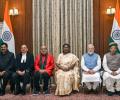
The Supreme Court's opinion on the presidential reference can impact on any number of cases if and when governors, if not the President, take a literary view of the Supreme Court's 'ppinion' on their 'discretionary powers' without reference to the rider on 'reasonable time', points out N Sathiya Moorthy.
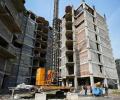
Observing an "unholy nexus" between the banks and developers to dupe homebuyers, the Supreme Court on Tuesday directed the CBI to register seven preliminary enquiries against builders in NCR, including Supertech Limited.
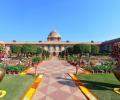
The Supreme Court has ruled that a Governor cannot send bills to the President for consideration if the state assembly has already cleared them for a second time. The court was questioning the Centre over the powers of the Governor when it comes to granting assent to bills.

The Supreme Court on Monday expressed its displeasure at the Delhi High Court Bar Association for questioning the representation of women judges in the top court while arguing for reservation for women lawyers in the high court bar. The court refused to hear further arguments from the bar body and set November 29 for final arguments on the issue of reservation. The court had previously directed the DHCBA to reserve the post of treasurer for a woman and consider reserving one more post for a woman in the five-member office-bearer body. It had also directed that at least three out of the 10 executive members be women, with at least one being a senior designated advocate.

The Supreme Court has put on hold the Uttar Pradesh government's plan to develop the Shri Banke Bihari Temple Corridor in Vrindavan, citing a lack of consultation with key stakeholders. The court questioned the state's approach and the urgency of enacting an ordinance to take over the temple's management.

The Supreme Court of India will hear a batch of pleas seeking a probe into the alleged unauthorised use of Pegasus spyware for the surveillance of journalists and others next week. The court had previously ordered a technical panel to investigate the matter but received no reports. Senior advocate Shyam Divan, appearing for some petitioners, urged the court to pass directions as the reports were not shared. The court has now listed the matter for hearing on April 29.
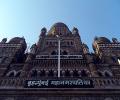
The Supreme Court has directed the Maharashtra state election commission to notify local body elections in the state within four weeks. The court also ruled that the contentious issue of OBC reservation in local body polls will be as it existed prior to the 2022 Banthia Commission report. The court accepted the commission's report, which recommended a census to fix exact data on OBCs and reserve 27 per cent seats for the category in local body polls in Maharashtra. The bench on Tuesday fixed a timeline for concluding the local body polls and asked the state panel to conclude it in four months. The outcome of Maharashtra local body elections would be subject to decisions in pending petitions before the apex court.
The Supreme Court would likely hear on Wednesday a plea of Ashoka University's faculty Ali Khan Mahmudabad against his arrest for his social media posts over Operation Sindoor.
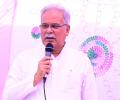
The Supreme Court declined to examine a plea challenging a PMLA provision, stating the issue lies in the law's abuse, not the law itself. The court allowed the petitioner to approach the High Court if procedures weren't followed.
The bench, which examined the online post by the professor, who heads the political science department in the Sonipat-based Ashoka University, questioned his choice of words, saying they were used deliberately to humiliate, insult, or put others in discomfort. "The choice of words are deliberately made to insult, humiliate or cause discomfort to others. The professor, who is a learned person cannot lack a dictionary... he could have conveyed the very same feelings in a simple language without hurting others. He should have shown respect for the sentiments of others. He could have used a simple and neutral kind of language, respecting others," Justice Kant said.
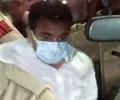
The Supreme Court on Monday gave bail to ex-Union minister Ajay Mishra's son Ashish Mishra in the case related to the 2021 Lakhimpur Kheri violence that claimed eight lives, and restricted his movement to Delhi or Lucknow.
The Tamil Nadu government has urged the Supreme Court to dismiss the Presidential reference concerning the Governor's powers to assent to bills, arguing it is an 'appeal in disguise' to overturn settled law.
The Election Commission has assured the Supreme Court that no voter's name will be deleted from the draft electoral roll in Bihar without prior notice and a fair hearing. The EC also clarified that it is not required to share separate lists of those not included in the draft rolls.

The committee said the Uttar Pradesh government did not file appeals against the high court's November 8, 2023 order and instead, an impleadment application was filed in the pending plea before the top court.
The Centre has told the Supreme Court that imposing fixed timelines on governors and the president to act on bills passed by a state Assembly would amount to one organ of the government assuming powers not vested in it by the Constitution and lead to a "constitutional disorder".
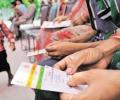
Expressing surprise over political parties not coming forward in filing objections related to 65 lakh excluded voters, the top court directed the chief electoral officer of Bihar to implead them in the court proceedings.
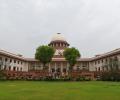
The Supreme Court of India has laid down guidelines for courts when ordering DNA tests to ascertain paternity. The court emphasized the need to balance the interests of all parties involved, including the child, parents, and other stakeholders. It also recognized the potential for infringement of privacy and the social stigma associated with illegitimate children. The court stressed that DNA tests should only be ordered when existing evidence is insufficient and when such tests are in the best interests of all parties involved.

A bench of Justices Surya Kant and Joymalya Bagchi is likely to take up the matter in which the EC has justified its ongoing SIR of electoral rolls in Bihar, saying it adds to the purity of the election by "weeding out ineligible persons" from the electoral rolls.
The Supreme Court of India has scheduled a hearing on February 19 for pleas challenging the appointment of the Chief Election Commissioner and Election Commissioners under the 2023 law. The court emphasized the potential consequences if any action is taken before the hearing. The pleas argue that the 2023 law, which excludes the Chief Justice of India from the selection panel, undermines the independence of the Election Commission and allows for undue influence from the executive branch. The court's earlier verdict in March 2023 called for an independent selection panel comprising the Prime Minister, Leader of the Opposition, and the Chief Justice of India to ensure the integrity of the Election Commission. The case highlights concerns about the independence of India's electoral process and the potential for political influence in the appointment of key election officials.

A two-judge bench of the top court in 1981 questioned the correctness of the 1967 verdict holding Aligarh Muslim University not to be a minority institution since it was created by a central law and referred the issue to a larger bench for decision.
A five-judge Constitution bench of the Supreme Court is scheduled to consider the Presidential reference on whether timelines could be imposed by judicial orders for the exercise of discretion by the President while dealing with bills passed by state assemblies.
